


Previous issue | Next issue | Archive
 Volume 15 (4); December 2025
| Phylogenetic analysis and antibacterial potency of indigenous mushrooms in Arabuko Sokoke forest, Kenya |
Research Paper
Phylogenetic analysis and antibacterial potency of indigenous mushrooms in Arabuko Sokoke forest, Kenya
Audrey MS, Kamau PK, and Neondo J.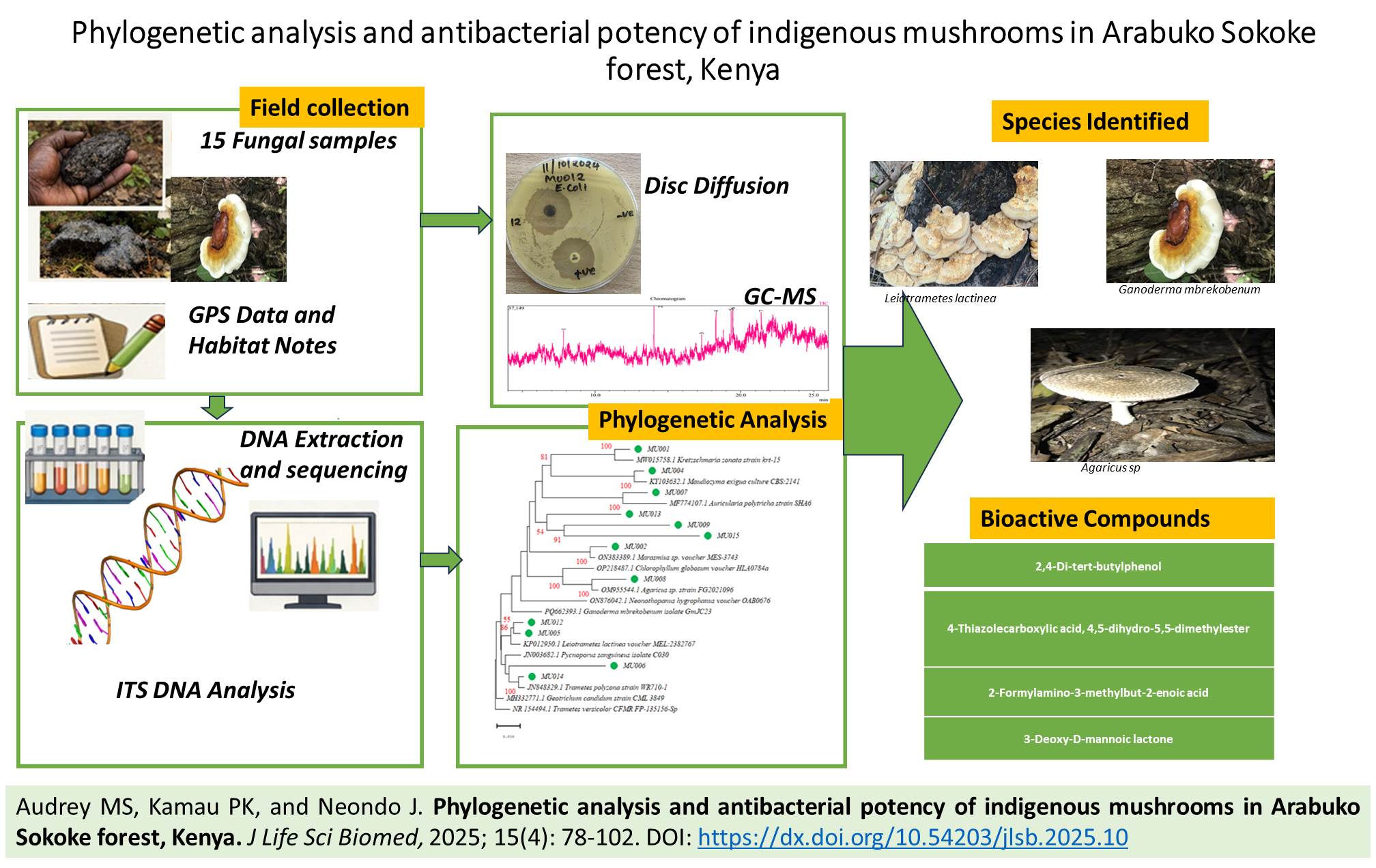 J. Life Sci. Biomed., 15(4): 78-102, 2025; pii:S225199392500010-15
DOI: https://dx.doi.org/10.54203/jlsb.2025.10
Abstract
Indigenous mushrooms are a rich source of bioactive compounds with potential pharmacological application. This study investigated the diversity, molecular identity and antibacterial activity of indigenous mushroom collected from Arabuko Sokoke forest, Kenya. Fifteen mushroom accessions were purposively sampled and subjected to DNA extraction using an optimized CTAB protocol. Molecular identification was carried out through ITS1 and ITS4 amplification followed by sequencing and phylogenetic analysis. Crude extracts of the mushrooms were screened for antibacterial activity against Escherichia coli (Gram-negative) and Staphylococcus aureus (Gram-positive) using the disc diffusion method. Active extracts were further profiled using Gas Chromatography-Mass Spectrometry to identify bioactive metabolites. Molecular docking was performed to predict compound-protein interactions with bacterial targets. Sequencing and phylogenetic analysis identified 12 distinct taxa, including Ganoderma mbrekobenum, Leiotrametes lactinea, Trametes polyzona and Auricularia polytricha. Among the 15 extracts, only G. mbrekobenum (MU005) and L. lactinea (MU012) exhibited antibacterial activity. The two mushrooms produced zones of inhibition of 24.1-34.3mm, which were comparable to or greater than ampicillin controls. Gas Chromatography- Mass Spectrometry profiling of these two mushrooms revealed four bioactive compounds: 2,4-di-tert-butylphenol, 3-deoxy-D-mannoic lactone, 4-thiazolecarboxylic acid derivative, and 2-formylamino-3-methylbut-2-enoic acid (unique to G. mbrekobenum). Molecular docking indicated strong binding affinities of these compounds for key bacterial enzymes, including dihydrofolate reductase, enolpyruvyl transferase, phospholipase A2, and penicillin-binding protein 1, which supports the observed antibacterial activity. The findings highlight G. mbrekobenum and L. lactinea as promising sources of antibacterial agents, with activity comparable to standard antibiotics. The integration of molecular identification, chemical profiling, and in silico docking provides a robust framework for further discovery of natural products. Further studies should expand antibacterial screening to more pathogens, determine minimum inhibitory concentration and minimum bactericidal concentration values, and validate compound activity through bioassay-guided fractionation.
Keywords: Antibacterial activity, Ganoderma mbrekobenum, GC-MS, Leiotrametes lactinea, Molecular docking.
[Full text-PDF] [ePub] [Export citation from ePrint] [How to Cite]
Previous issue | Next issue | Archive
 This work is licensed under a Creative Commons Attribution 4.0 International License (CC BY 4.0)
