



















Previous issue | Next issue | Archive
 Volume 16 (1); March 2026
| Prevalence of Helicobacter pylori infection and associated risk factors among patients with active pulmonary tuberculosis and healthy controls in Northwest Ethiopia |
Research Paper
Prevalence of Helicobacter pylori infection and associated risk factors among patients with active pulmonary tuberculosis and healthy controls in Northwest Ethiopia
Belete D, Eshetie S, and Tegene B. 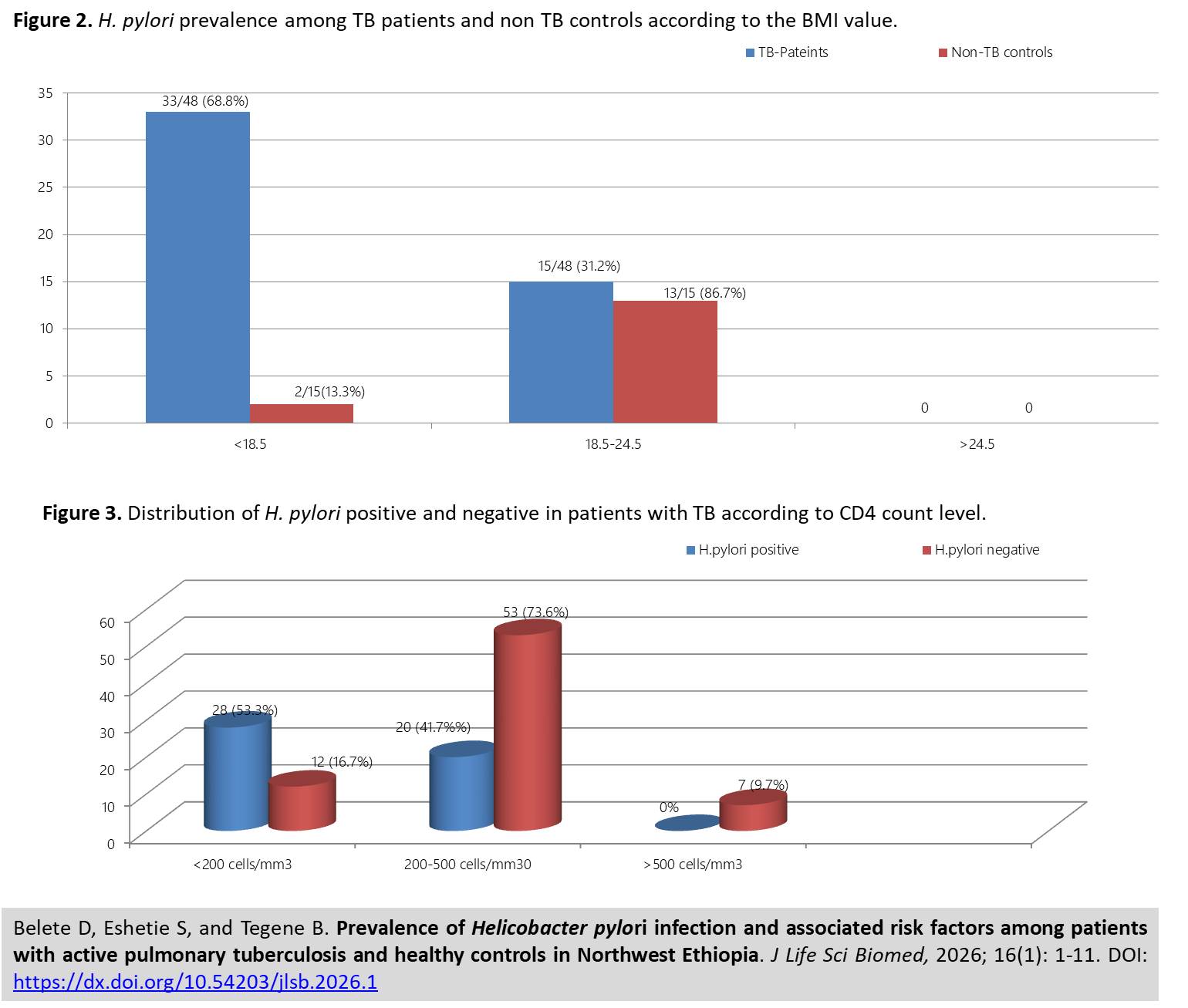 J. Life Sci. Biomed., 16(1): 1-11, 2026; pii:S225199392600001-16
DOI: https://dx.doi.org/10.54203/jlsb.2026.1
Abstract
Helicobacter pylori remains a major public health problem and the burden of infection is more pronounced in the resource-limited countries including Ethiopia. The tuberculosis (tb) is also the most prevalent infectious diseases, especially in low income settings. To date, the association between Helicobacter pylori and Mycobacterium tuberculosis infection is controversial. Thus, this study aimed to determine the prevalence and associated factors of H. pylori infection among TB patients and apparently healthy controls. To assess the prevalence and associated risk factors of H. pylori infection among patient with active pulmonary tuberculosis and healthy controls. A comparative cross-sectional study was conducted at Gondar university hospital, Debark Hospital, kolladiba HC, sanja HC and HCs found in Gondar town from February to May 2017. A convenient sampling technique was carried out to enroll 120 known active pulmonary tuberculosis patients and the same number of apparently healthy controls. A structured questionnaire was used to collect data. Approximately three grams of stool sample were collected, which is aimed to assess the presence of H. pylori antigen using rapid test strip. Besides, standard volume of blood sample were also collected and analyzed using BD FACS count and Sysmex K-21, in order to estimate CD4+ T cell count and white blood cell count. A P-value <0.05 was considered as statistical significant. The prevalence of H. pylori infection among TB patients and non TB controls were 48 (40%) and 15 (12.5%), respectively. Alcoholic individual (AOR = 7.2 (95% CI: 1.97-26.2) and 6.2 (95% CI: 1.6-24.71,) were significantly associated with the development of H. pylori infection in TB cases and healthy controls respectively, underweight (AOR= 4.1 (95% CI: 1.46-11.53) and lymphocyte count <20% (AOR=11.3 (95% CI: 1.6-45) were significantly associated with the development of H. pylori infection in TB cases. H. pylori infection among TB patients was significantly higher than non TB controls. Health education targeting on the risks of H. pylori infection should be considered to the general population.
Keywords: Prevalence, H. pylori, active Tuberculosis, CD4+ Lymphocyte.
[Full text-PDF] [ePub] [Export citation from ePrint] [How to Cite]
Previous issue | Next issue | Archive
 This work is licensed under a Creative Commons Attribution 4.0 International License (CC BY 4.0)
